

Football · May 05, 2026
Arsenal vs Atlético Madrid: Champions League Semi-Final Review
A narrow European tie was settled by Arsenal’s clean-game discipline and one captain’s touch before half-time.
Football · May 05, 2026
A narrow European tie was settled by Arsenal’s clean-game discipline and one captain’s touch before half-time.
Champions League semi-finals rarely reward impatience. Arsenal’s meeting with Atlético Madrid was a test of whether the club could stay balanced under the weight of a final place. The answer was found not in a wild attacking display, but in a performance that kept danger at arm’s length.
The result carried historic meaning because Arsenal moved into only their second Champions League final. For a team already chasing domestic success, the semi-final became proof that the season’s momentum could travel across competitions rather than breaking under the schedule.
Atlético brought the expected resistance. They narrowed space, contested second balls and tried to turn every Arsenal attack into a problem of patience. Arsenal did not always move quickly, but they rarely lost the shape of the match. That was central to the win.
The first half remained tight until the decisive movement arrived before the interval. Saka’s finish gave Arsenal both a scoreboard advantage and a psychological one. From that point, Atlético had to chase, and Arsenal could manage territory with the aggregate score in their favour.
The defining period came after Arsenal had gone ahead. In many semi-finals, that is when the leading side drops too deep and invites a wave. Arsenal avoided that trap by keeping enough possession to slow Atlético and enough compactness to close the central routes.
Their ninth clean sheet of the campaign was not an accident. It reflected repeated habits: aggressive first pressure, quick support around loose balls and a back line that trusted the midfield screen instead of constantly retreating toward goal.
Arteta’s side worked the game like a team comfortable with small advantages. They were not careless with transitions and did not flood the box unless the attack had proper protection behind it. That restraint can be frustrating for neutral viewers, but in a semi-final it is often the difference between control and regret.
Atlético’s limitation was their inability to force enough broken sequences. They needed the match to become rougher and more unpredictable. Arsenal kept it cleaner, and a clean match suited the team with the aggregate edge.
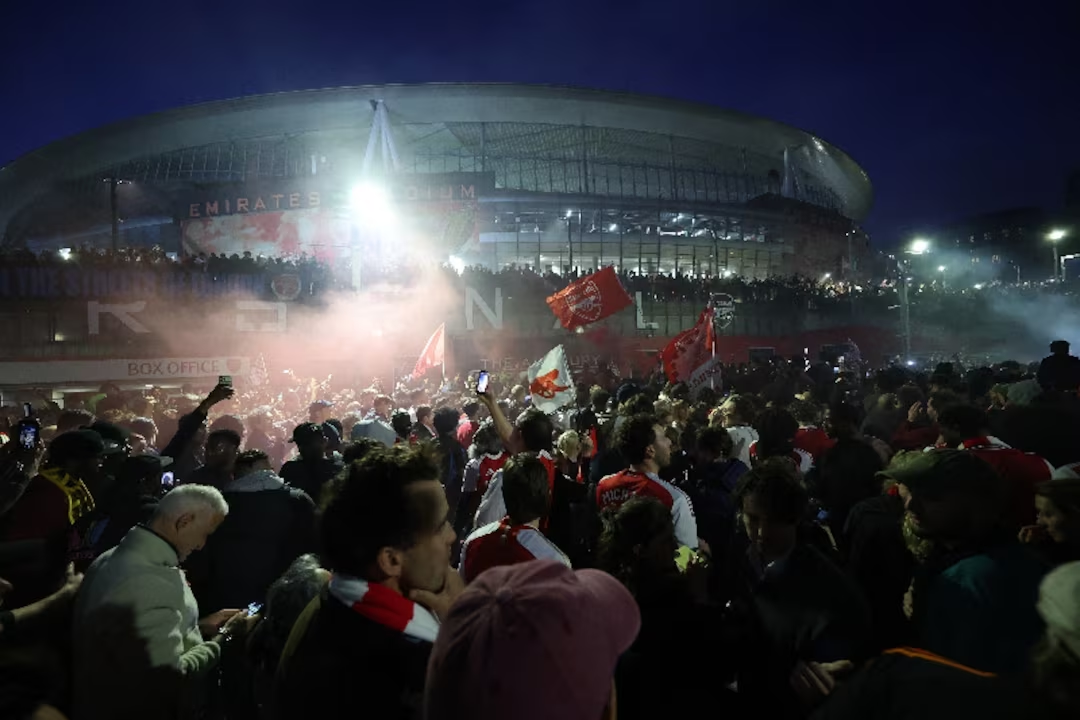
For Arsenal supporters, the night felt like a shift in status. Reaching the final was not presented as a miracle; it felt like a team arriving where its season had suggested it could go. That distinction matters because it signals confidence rather than surprise.
The semi-final also sharpened the club’s final weeks. Arsenal were not only fighting for a league title; they were now carrying a European final into the same emotional space. That makes the achievement larger and the pressure more intense.
This was not a semi-final won by chaos. Arsenal advanced through organisation, timing and one decisive attacking detail. That makes the performance a useful measure of the team’s maturity.
Atlético made the tie demanding, but Arsenal gave it structure. In Europe, that can be the most valuable quality of all.
Further reading

A rewritten long-form event review of Aston Villa’s 3-0 win over SC Freiburg in the UEFA Europa League final, with the focus on tempo, control and what the result changes for the club.

A long-form rewrite of Manchester City’s 1-0 FA Cup final win over Chelsea, focusing on Semenyo’s decisive finish and the rhythm of a tense Wembley match.
A rewritten review of Arsenal’s first Premier League title in 22 years, looking at how the decisive final week changed the mood around the club.